An independent design-research lab

Intelligence isn't locked in the mind or the machine. It is enacted across bodies, artefacts, and environments.

Embodied Intelligence Labs LLP is an independent, practice-based design-research lab working at the intersection of design, computation, media arts, and the digital humanities. We pursue research programmes, run a digital incubation, and teach short courses.

About the lab

Research Orientation.

We take one stance across all of our work: that intelligence, cognition, and computation are not confined to the individual mind or the digital machine. They are enacted in real time across bodies, artefacts, social arrangements, and material environments. Our research programmes carry this commitment into post-cognitive, post-human, phenomenological, and spatial registers.

The lab is founded and led by Abhay Vohra — a systemic designer and design researcher with more than twenty-five years in interface and interaction design, a full-time researcher since 2023, and visiting faculty at top design universities in India.

Research programmes

Our research.

Active · anchor

Post-Cognitive Design & Computing

Our founding programme. It studies how cognition and computation extend beyond the individual mind and the digital machine — across people, artefacts, and environments — and how knowledge is represented and encoded in data, with a view to designing computational systems inspired by collective cognition. It also relates phenomenological philosophy to computation: how computational artefacts mediate perception and action, and where the formal, representational account of machine intelligence reaches its limits.

Research outcomes Systemic Design Through the Lens of Distributed Cognition · RSD13 Proceedings, 2024
Simulating AI-enabled Services Using a Human Element · Touchpoint Vol. 11 No. 2, 2020
Embodied Intelligence: Alternative Computing Practices for a Contingent World · Workshop accepted at EKSIG 2025
Further work under peer review.

Distributed cognition network diagram
Perception and de-centring diagram
Developing

Post-Human Design & Computing

Methods to bring post-human and new-materialist thought to bear on computation and design. Its provocation is to de-centre the human — to move from designing for users toward designing with a multitude of human and non-human entities.

Research outcomes Rethinking Design in the Anthropocene · Workshop submitted to India HCI 2025
Relational city plan diagram
Active

Socio-Spatial Design & Computing

Grounded in critical geography and non-representational theory, this programme reads space not as a fixed backdrop but as relational — continuously produced through practice, negotiation, and movement. It studies the planned city as a lived, relational system, sustained by informal, embodied, and negotiated practices that formal plans alone cannot account for.

Research outcomes Navigating Urban Space: Chandigarh · RSDx session, RSD14, 2025

Short courses

Learn to apply cutting-edge research to your creative practice.

Our short courses are drawn directly from our cutting-edge, practice-based research programmes — live thinking, not a settled curriculum. The aim is to learn how to apply these methods to your own creative practice — tracing the social, cognitive, and material contexts that surround your work. This matters more, not less, in an age when AI can generate fluent, plausible work in any style: knowing your own contexts and commitments is what keeps a subjective signature in your work, so it remains unmistakably yours.

Each course is project-based, built around a piece of work you carry through from question to outcome rather than a fixed syllabus delivered to a calendar, over a duration of four to twelve weeks. Eligibility is open to students who have completed at least six semesters of a bachelor's programme, those enrolled in a master's programme, and research scholars.

Three interlocking research territories diagram

Post-Cognitive Design & Computing: Digital Interfaces

Based on our Post-Cognitive Design & Computing programme. The digital interface treated not as a screen to be designed, but as a site where social, technical, and material forces meet — bound together by causal relationships and feedback loops. For practitioners moving beyond user-centred heuristics toward a systems-thinking orientation.

4–12 weeks · project-based

Socio-Spatial Design & Computing: Social Design

Based on our Socio-Spatial Design & Computing programme. Social influence studied as a systemic phenomenon — the causal relationships and feedback loops it generates, and the ecosystems it is embedded in. Gives practitioners conceptual and practical tools for working with complex social systems.

4–12 weeks · project-based

Post-Human Design & Computing: Designing Beyond the User

Based on our Post-Human Design & Computing programme. A practice-based introduction to post-human and new-materialist methods in design — moving from designing for a human user toward designing with the multitude of human and non-human entities a system actually involves. Equips practitioners to ask who and what a design decision affects beyond its intended user.

4–12 weeks · project-based

Open calls

Participate in our research programmes.

Inspired by the open-source model, we post research call abstracts and calls for participation in our LinkedIn community, interembodied. Anyone is welcome to take up an open call, or propose a project of their own for our guidance.

There is no application, no fee, and no fixed term. It is where ideas get tested before they grow into full-fledged research programmes.

Field diagram — the lab's research landscape

Digital incubation

Join our Digital Incubation programme.

We invite creative practitioners — design researchers, creative technologists, media artists, architects, and social science practitioners — into a distributed, short-term incubation built around a specific line of inquiry. Each cohort is application-based and investigates a different question; participants are paired with a collaborator from the lab and supported through mentorship, showcases, and academic outputs. As a participant you can expect:

  • a collaborator paired to complement your own skill set, plus ongoing mentorship from the lab;
  • support to show your work at festivals, and co-authorship on papers for international conferences where the work supports it;
  • full creative control over the artefact you make — the medium is yours to choose.

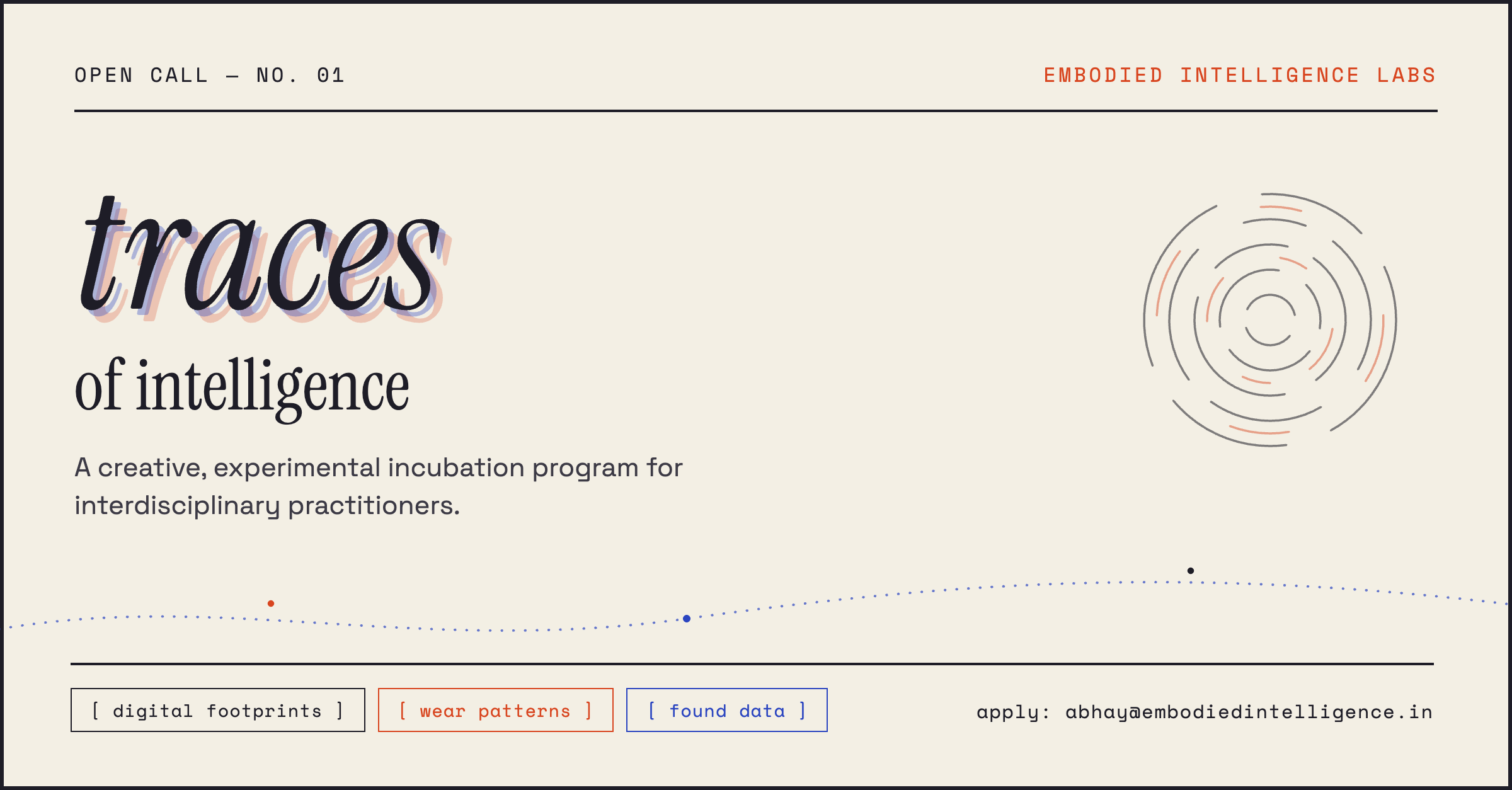
Now open: Traces of Intelligence

Traces of Intelligence — current Digital Incubation cohort